
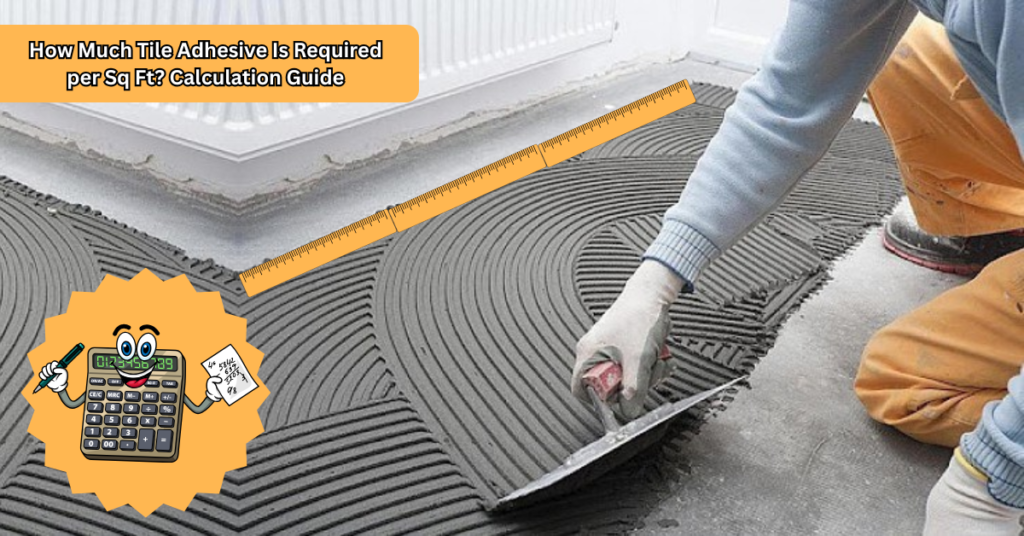
Before starting any tiling project, one important question comes up: how much material do we actually need? Understanding tile adhesive coverage helps contractors avoid material shortage, wastage, and unnecessary cost.
Whether you are working on a bathroom, kitchen, commercial floor, or full residential project, calculating the correct quantity ensures smooth progress on site.
How Much Tile Adhesive Per Square Meter?
On average, how much tile adhesive per square meter depends on tile size and trowel notch depth. For standard floor tiles (600×600 mm) using a 10mm notch trowel:
- Approximate consumption: 4 to 5 kg per square meter
For smaller wall tiles with an 8mm notch:
- Approximate consumption: 3 to 4 kg per square meter
However, surface level and substrate condition also affect tiles adhesive coverage. Uneven floors increase consumption.
Tile Adhesive Coverage: How Much Tile Adhesive Do You Really Need? Learn More….
Tile Adhesive Coverage Per Kg
Many contractors calculate using tile adhesive coverage per kg for quick estimation.
As a general rule:
- 1 kg tile adhesive covers around 0.20 to 0.25 square meter
- Coverage may vary based on application thickness
This calculation helps when estimating partial work areas or small repair jobs.
20kg Tile Adhesive Coverage Per Square Foot
For Indian contractors, bags usually come in 20kg or 25kg packaging. So, understanding 20kg tile adhesive coverage per square foot is practical.
On average:
- A 20kg tile adhesive coverage ranges between 45 to 55 square feet for standard 600×600 mm tiles.
If tiles are larger or back-buttering is required, coverage may reduce slightly.
So, when someone asks how much tile adhesive per square foot, the answer depends on tile size and surface condition. Typically:
Around 0.4 to 0.5 kg per square foot
20kg Tile Adhesive Coverage – Quick Example
Let’s take a real site example.
If you have a 500 square foot floor area:
- Average requirement = 500 × 0.45 kg
- Total needed ≈ 225 kg
That means you need around 11 to 12 bags of 20kg tile adhesive.
Proper calculation of adhesive coverage prevents mid-project delays and emergency material purchases.
Factors That Affect Adhesive Coverage
Several site conditions influence actual consumption:
- Surface unevenness
- Tile size (large format tiles need more adhesive)
- Trowel notch size
- Back buttering method
- Installation thickness
Therefore, always check manufacturer recommendations before final calculation.
Contractor Tip for Accurate Estimation
For Indian projects, always add 5–10% extra material as buffer. This ensures continuous workflow and avoids labour downtime.
Correct estimation of how much tile adhesive per square meter or how much tile adhesive per square foot directly impacts project cost control and material planning.
Final Words
Understanding tile adhesive coverage per kg and 20kg tile adhesive coverage per square foot helps contractors plan smarter. Instead of guessing quantities, use proper calculations based on tile size and surface condition.
Accurate planning means less wastage, better bonding, and smoother project execution.



0 Comment