
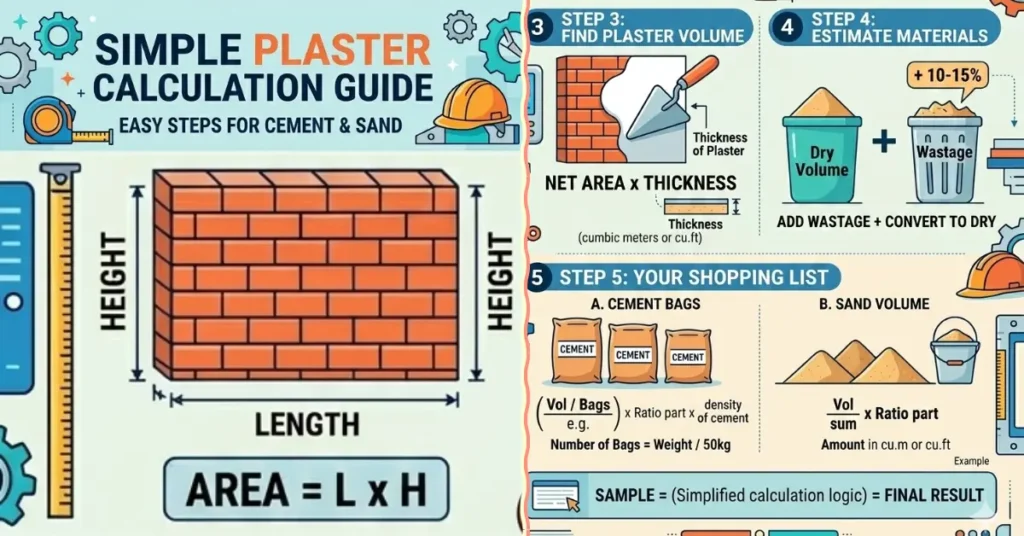
Plastering is an essential step in construction because it creates a smooth and durable surface on walls and ceilings. Many contractors and homeowners often search for the correct plaster quantity calculation method before starting their work. Knowing the exact amount of material required helps reduce waste and ensures proper budgeting.
Using a plaster calculator or understanding the manual formula makes it easier to estimate cement and sand requirements. In this guide, we will explain the simple process of plastering material calculation and how to perform accurate plaster calculation for wall surfaces.
What is Plaster Quantity Calculation?
Plaster quantity calculation refers to estimating the amount of cement, sand, and water needed for plastering a wall or ceiling surface. This calculation depends mainly on three factors:
- Total wall area
- Thickness of plaster
- Cement and sand ratio
Construction professionals usually use a plaster calculator to speed up this process. However, learning the manual formula for plastering material calculation helps you understand the exact requirements for any project.
Step-by-Step Plaster Calculation for Wall
Follow these steps to perform accurate plaster calculation for wall surfaces.
1. Measure the Wall Area
First measure the height and width of the wall.
Formula:
Wall Area = Length × Height
Example:
Length = 5 meters
Height = 3 meters
Wall Area = 5 × 3 = 15 m²
This value becomes the base for plaster quantity calculation.
2. Decide the Plaster Thickness
Standard plaster thickness usually ranges between:
- 12 mm for internal walls
- 15 mm for external walls
Thickness affects the total plastering material calculation, so always confirm it before estimating materials.
3. Calculate Wet Volume of Plaster
Wet Volume = Area × Thickness
Example:
15 m² × 0.012 m = 0.18 m³
This is the initial result of the plaster calculation for wall.
4. Convert Wet Volume to Dry Volume
Construction calculations typically add 30% extra volume to account for wastage and shrinkage.
Dry Volume = Wet Volume × 1.3
0.18 × 1.3 = 0.234 m³
This value is used in final plaster quantity calculation.
5. Cement and Sand Calculation
For a common plaster ratio of 1:4 (cement:sand):
Total parts = 1 + 4 = 5
Cement = (1/5) × 0.234 = 0.0468 m³
Sand = (4/5) × 0.234 = 0.1872 m³
Convert cement volume to bags:
1 bag cement ≈ 0.035 m³
Cement required = 0.0468 / 0.035 ≈ 1.34 bags
This completes the plastering material calculation for the wall.
Why Use a Plaster Calculator?
Many builders now use an online plaster calculator because it provides quick and accurate results. It helps estimate material requirements instantly without manual calculations.
Benefits of using a plaster calculator include:
- Faster plaster quantity calculation
- Reduced material wastage
- Accurate cost estimation
- Better construction planning
However, understanding manual plastering material calculation still remains useful for contractors on-site.
Tips for Accurate Plaster Calculation
To ensure precise plaster calculation for wall, follow these tips:
- Always measure wall dimensions carefully
- Confirm plaster thickness before calculation
- Use the correct cement-sand ratio
- Add 25–30% extra volume for dry materials
These steps improve the accuracy of your plaster quantity calculation and help avoid shortages during construction.
Conclusion
Understanding plaster quantity calculation is essential for any construction or renovation project. By measuring the wall area, deciding plaster thickness, and applying the correct formula, you can easily estimate material requirements.
Whether you use a manual method or an online plaster calculator, proper plastering material calculation ensures efficient use of cement and sand. Accurate plaster calculation for wall surfaces not only saves money but also improves construction quality.
FAQ – Plaster Quantity Calculation
What is plaster quantity calculation?
Plaster quantity calculation is the process of estimating the amount of cement and sand required for plastering a wall or ceiling surface.
How does a plaster calculator work?
A plaster calculator calculates the required materials based on wall area, plaster thickness, and cement-sand ratio.
What is the standard plaster thickness for walls?
Internal walls usually use 12 mm plaster, while external walls commonly require 15 mm plaster.
Why is dry volume used in plastering material calculation?
Dry volume is used because plaster materials expand and shrink during mixing, so 30% extra volume is added for accurate plastering material calculation.
How do you perform plaster calculation for wall surfaces?
To perform plaster calculation for wall, multiply wall area by plaster thickness, convert to dry volume, and divide the result according to the cement-sand ratio.



0 Comment