
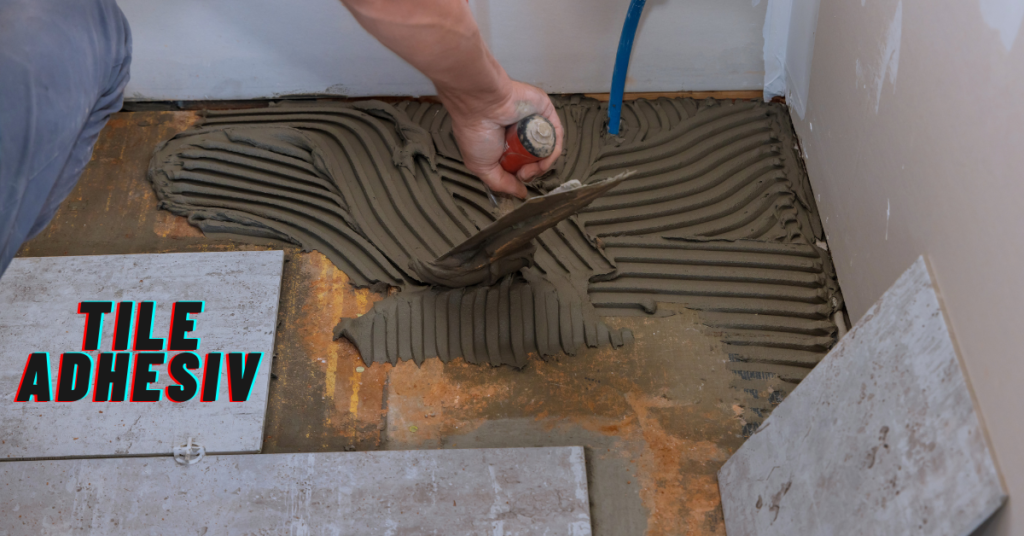
Tile installation plays an important role in the durability and appearance of any residential or commercial space. Tile adhesive has become the preferred material for modern tile fixing because it offers better bonding and long-term performance. As construction methods evolve, understanding tile adhesive uses, types, and benefits helps homeowners and contractors make informed decisions.
In today’s construction industry, tile adhesive is widely used instead of traditional cement mortar due to its strength, ease of application, and reliability.
What Is Tile Adhesive?
Tile adhesive is a specially formulated bonding material used to fix tiles on floors and walls. Unlike conventional cement mortar, it contains polymers and additives that improve adhesion and flexibility. As a result, tiles remain firmly fixed even under load and temperature changes.
Moreover, tile adhesive is available in both dry-mix and ready-mix forms, making it suitable for different project requirements.
Tile Adhesive Uses
Tile adhesive is used in a wide range of applications across residential and commercial projects. Some of the most common uses include the following:
1. Floor Tile Installation
Tile adhesive is commonly used for fixing ceramic, vitrified, porcelain, and stone tiles on floors. Because of its strong bonding strength, it prevents tiles from loosening over time.
2. Wall Tile Fixing
Wall tiles in kitchens and bathrooms require strong initial grip. Therefore, tile adhesive helps tiles stay in place without slipping during installation.
3. Bathroom and Kitchen Applications
Bathrooms and kitchens are constantly exposed to moisture. For this reason, water-resistant tile adhesive is used to ensure long-lasting performance in wet areas.
4. Tile on Tile Fixing
During renovation work, tile adhesive allows new tiles to be fixed over existing tiles. As a result, time and demolition costs are significantly reduced.
5. Large Format Tile Installation
Large and vitrified tiles require high bonding strength. In such cases, polymer-modified tile adhesive is the most suitable choice.
Types of Tile Adhesive
Different projects require different adhesive solutions. Therefore, understanding the types of tile adhesive is essential.
| Cement-Based Tile Adhesive This is the most commonly used adhesive for tile installation. It is suitable for ceramic tiles and standard floor and wall applications. Additionally, it is cost-effective and easy to apply. | Polymer-Modified Tile Adhesive Polymer additives improve flexibility and bonding strength. As a result, this adhesive is ideal for vitrified tiles, large tiles, and high-traffic areas. |
| Ready-Mix Tile Adhesive Ready-mix adhesive comes pre-mixed and requires no additional preparation. For example, it is commonly used for small repairs and wall tile applications. | Tile on Tile Adhesive This adhesive is designed specifically for renovation projects. Moreover, it provides excellent adhesion over existing tile surfaces. |
Benefits of Tile Adhesive
Using tile adhesive offers several advantages compared to traditional tile fixing methods.
Firstly, tile adhesive provides strong and durable bonding, reducing tile movement and cracks.
Secondly, it allows faster installation due to thin-bed application.
In addition, material wastage is significantly lower compared to cement mortar.
Moreover, tile adhesive ensures a clean and professional finish.
Finally, it improves the overall lifespan of tile installation.
Tile Adhesive vs Cement Mortar
| Feature | Tile Adhesive | Cement Mortar |
|---|---|---|
| Bonding Strength | High | Moderate |
| Application Thickness | Thin | Thick |
| Installation Speed | Faster | Slower |
| Material Wastage | Low | High |
| Durability | Long-lasting | Limited |
Tile adhesive is the preferred choice for modern tile installation.
How to Choose the Right Tile Adhesive
Before selecting tile adhesive, consider the tile type, tile size, application area, and moisture exposure. Additionally, traffic load and surface condition should also be evaluated. Choosing the correct adhesive ensures better performance and reduces future repair costs.
Choosing the right adhesive ensures better performance and fewer tile problems.
Final Thoughts
Understanding tile adhesive uses, types, and benefits is essential for achieving durable and high-quality tile installation. Whether you are working on a new project or a renovation, tile adhesive offers superior bonding, ease of use, and long-term reliability.
As a result, high-quality tile adhesive has become the preferred solution for modern floor and wall tile fixing.



0 Comment