
Best Tile Adhesive in India: Complete Buying Guide (2026)
AI Overview (Quick Answer)
The best tile adhesive depends on your tile type, surface, and installation area. For ceramic tiles, a standard cement-based adhesive is usually sufficient, while vitrified, porcelain, large-format, and outdoor tiles often require high-performance polymer-modified adhesives. Choosing the correct adhesive improves bonding strength, reduces tile cracking, and increases the life of your flooring or wall installation.
Table of Contents
- Introduction
- What is Tile Adhesive?
- Why Tile Adhesive is Better Than Cement Mortar
- Types of Tile Adhesives
- Advantages of Using Tile Adhesive
- Where Can Tile Adhesive Be Used?
- How to Choose the Right Tile Adhesive
- Step-by-Step Tile Adhesive Application
- Common Mistakes
- Expert Tips
- Why Professionals Prefer Tile Adhesive
- Why Choose Home Pride Tile Adhesives?
- Conclusion
- Frequently Asked Questions (FAQs)
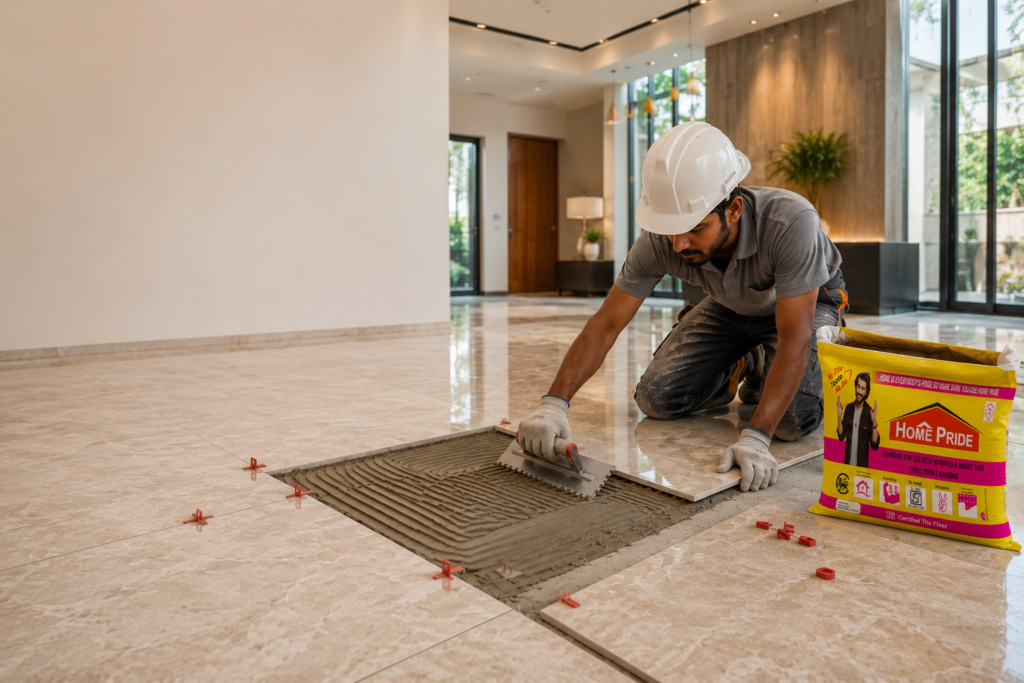
Introduction
Tiles have become one of the most popular flooring and wall solutions for modern homes and commercial buildings. However, the durability of any tile installation depends not only on the quality of the tile but also on the adhesive used beneath it.
Traditional cement mortar is still used in many projects, but professional builders and contractors now prefer tile adhesives because they provide stronger bonding, faster installation, and longer-lasting performance.
In this guide, you’ll learn everything you need to know about choosing the best tile adhesive in India, including adhesive types, applications, benefits, common mistakes, and expert tips.
What is Tile Adhesive?
Tile adhesive is a specially formulated construction chemical designed to fix tiles securely on walls and floors. It is made using cement, graded sand, polymers, and performance-enhancing additives that provide excellent bonding and flexibility.
Unlike traditional cement mortar, tile adhesive creates a stronger bond while requiring a thinner application layer.
Why Tile Adhesive is Better Than Cement Mortar
Tile Adhesive | Cement Mortar |
Strong bonding | Medium bonding |
Crack resistant | Higher crack risk |
Faster installation | Time-consuming |
Less material required | More material required |
Better water resistance | Lower water resistance |
Suitable for large tiles | Limited performance |
Types of Tile Adhesives
1. Ceramic Tile Adhesive
Ideal for:
- Ceramic floor tiles
- Ceramic wall tiles
- Residential projects
Advantages
- Easy to apply
- Affordable
- Strong bonding for standard tiles
Lorem ipsum dolor sit amet, consectetur adipiscing elit. Ut elit tellus, luctus nec ullamcorper mattis, pulvinar dapibus leo.
2. Vitrified Tile Adhesive
Recommended for:
- Double charge vitrified tiles
- Polished vitrified tiles
- Heavy floor tiles
Benefits
- Higher bonding strength
- Better flexibility
- Reduced hollow sound
3. Porcelain Tile Adhesive
Porcelain tiles absorb very little water, making them difficult to bond using traditional mortar.
A polymer-modified adhesive provides:
- Excellent grip
- Long life
- Crack resistance
4. Large Format Tile Adhesive
Large tiles require superior adhesion because of their weight.
Suitable for
- 600×1200 mm tiles
- 800×1600 mm slabs
- Marble look tiles
Advantages of Using Tile Adhesive
Strong Bond
Provides excellent adhesion between tile and substrate.
Faster Installation
Ready-mix formulations reduce labor time.
Less Wastage
Only a thin adhesive layer is required.
Better Waterproof Performance
Suitable for bathrooms, kitchens, and balconies.
Long Service Life
Proper installation can last for decades.
Where Can Tile Adhesive Be Used?
Tile adhesive is suitable for:
- Living rooms
- Bedrooms
- Kitchens
- Bathrooms
- Parking areas
- Balconies
- Commercial buildings
- Shopping malls
- Hospitals
- Hotels
How to Choose the Right Tile Adhesive
Consider these factors:
Tile Size
Large tiles require high-performance adhesive.
Tile Material
Ceramic, porcelain, vitrified, natural stone, and glass tiles all require different adhesive grades.
Surface
Different substrates require different adhesives:
- Concrete
- Cement plaster
- Existing tiles
- AAC blocks
- Gypsum boards
Location
Indoor and outdoor installations have different performance requirements.
Step-by-Step Tile Adhesive Application
Step 1
Clean the surface.
Step 2
Mix adhesive according to the manufacturer’s instructions.
Step 3
Apply using a notched trowel.
Step 4
Place the tile firmly.
Step 5
Use tile spacers.
Step 6
Allow proper curing before grouting.
Common Mistakes
Avoid these mistakes:
- Applying adhesive on dusty surfaces
- Mixing too much water
- Using expired adhesive
- Incorrect trowel size
- No tile spacers
- Walking on tiles too early
Expert Tips
✔ Always prepare the surface properly.
✔ Choose adhesive based on tile type.
✔ Follow the recommended curing time.
✔ Use quality grout after fixing tiles.
✔ Follow the manufacturer’s application guidelines.
Why Professionals Prefer Tile Adhesive
Professional contractors choose tile adhesive because it offers:
- Better productivity
- Cleaner application
- Reduced labor
- Improved tile alignment
- Long-term durability
Why Choose Home Pride Tile Adhesives?
Home Pride offers high-quality tile adhesive solutions designed for residential, commercial, and industrial applications. Our products are formulated to provide strong bonding, excellent workability, and reliable performance across different tile types and installation conditions.
Conclusion
Selecting the right tile adhesive is one of the most important decisions in any tiling project. The correct adhesive improves bond strength, reduces maintenance, and extends the life of your flooring and wall finishes. Whether you’re installing ceramic, vitrified, porcelain, or large-format tiles, matching the adhesive to the tile type and application ensures the best results.
Frequently Asked Questions (FAQs)
1. Which tile adhesive is best for vitrified tiles?
Polymer-modified tile adhesive is generally recommended because it provides stronger bonding for low-absorption vitrified tiles.
2. Can tile adhesive be used on walls?
Yes. Many tile adhesives are specifically formulated for wall tile installation and help prevent tile slippage.
3. Is tile adhesive waterproof?
Many tile adhesives offer water-resistant properties, but wet areas may also require a dedicated waterproofing system before tiling.
4. How thick should tile adhesive be?
The required thickness depends on the tile size and the trowel notch used. Follow the product’s application guidelines.
5. Can tile adhesive be applied over existing tiles?
Some high-performance adhesives are suitable for tile-on-tile applications if the existing surface is sound, clean, and properly prepared.
6. How long does tile adhesive take to dry?
Drying and curing times vary by product, temperature, and humidity. Always follow the manufacturer’s recommendations before grouting or using the tiled surface.
7. Is tile adhesive better than cement mortar?
For most modern tile installations, tile adhesive offers stronger bonding, easier application, and better long-term performance than traditional cement mortar.
8. Does tile adhesive reduce hollow tiles?
Correct adhesive selection and proper installation techniques can significantly reduce the risk of hollow-sounding tiles.



0 Comment